
Why resisting the market’s latest obsession and sticking with evidence, factor tilts, and a repeatable process remains one of an investor’s most valuable advantages.
Every market cycle produces a shiny object. Sometimes it is a country, sometimes a sector, and sometimes a company whose investor presentation includes more rockets than revenue. In recent years, the candidates have included mega-cap technology, artificial intelligence, crypto-focused stocks, and others. The story changes; the behavioral reflex does not.
Once an asset class has risen far enough and attracted enough coverage, the question arrives: “Why don’t we own more of that?” And of course, the question usually arrives after the price has already increased. Recency bias makes the latest returns feel permanent. Availability bias gives vivid, heavily covered ideas more mental weight than quieter evidence. Social proof turns “everyone is talking about it” into “everyone should own it.”
Academic research has documented the pattern for decades. Investors direct disproportionate cash toward recent top-performing funds, and media attention makes those winners even more salient. Other research finds that these reallocations have historically reduced investors’ long-horizon wealth. As you might have guessed, FOMO does not appear in peer-reviewed research as a factor in higher expected returns!
The leaderboard changed. Our process has not.
Through July 24, 2026, a selected group of broad ETF proxies told a story that received less airtime than the usual technology narrative. U.S. small-cap value returned 20.1% year to date, followed by micro-cap stocks at 19.2% and large-value stocks at 18.9%. The S&P 500 (a.k.a. shiny object) returned 9.0%, while total international equities returned 11.2%.
Those figures are not portfolio returns; they are asset class returns, and one snapshot is not a comprehensive ranking. But they illuminate an important point: investors did not need a late, concentrated bet on the asset class of the moment to participate in attractive returns. Our investment approach already incorporated deliberate overweights to small-cap, micro-cap, and value stocks, alongside intentionally broad global diversification. We did not add those exposures because they became exciting. We owned them before they became exciting.
That discipline also meant we did not chase technology after its run, build a space-themed allocation because the narrative was captivating, or rotate toward any other “asset class of the moment.” That is the difference between reacting to returns and following a process.
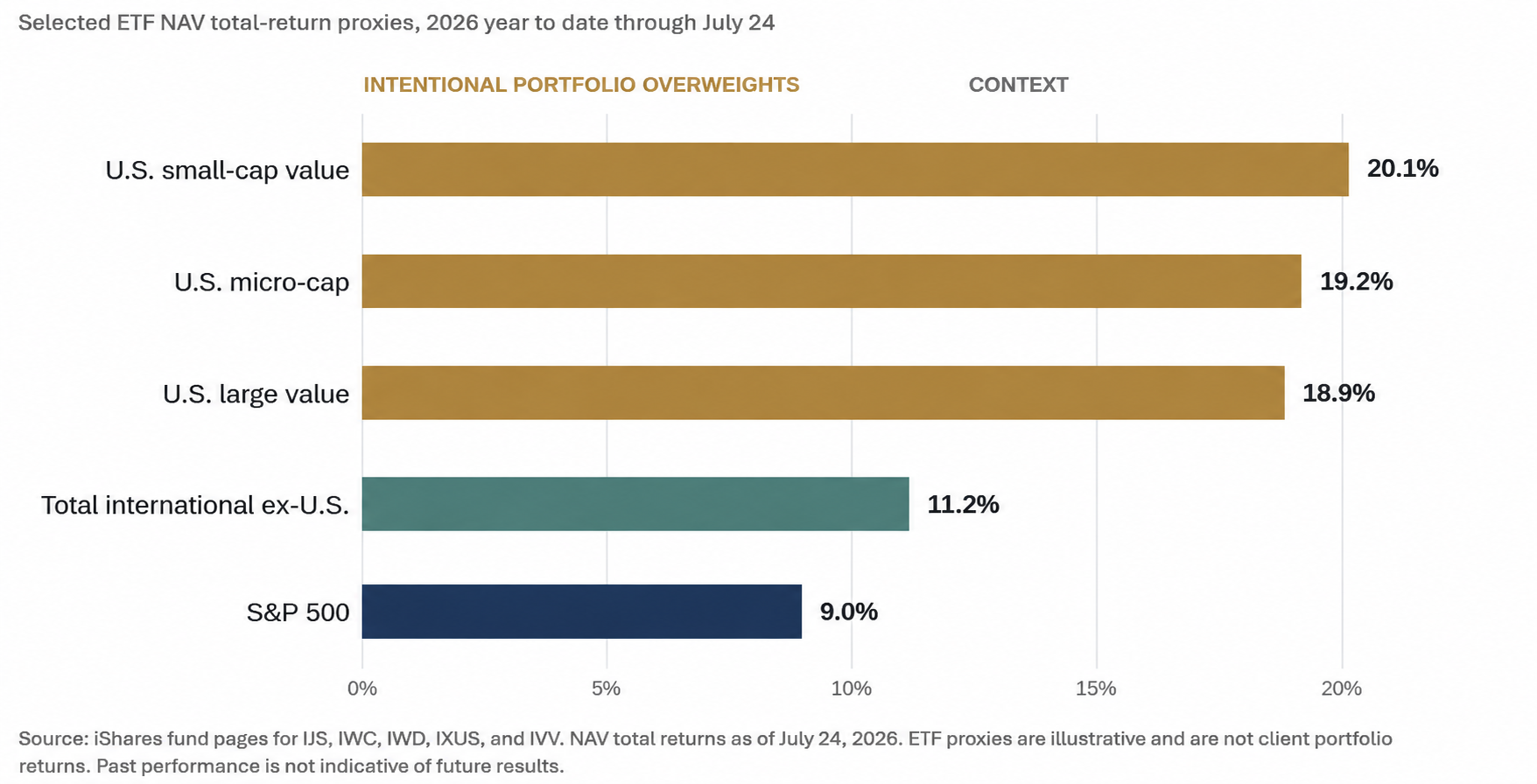
Investment Return Leadership Was Broader Than the Headlines
A good dose of humility is required to remind ourselves that a good year is simply an illustration, not proof that a strategy always works. Over short periods, asset class returns may be noisy and unpredictable, and leadership can change quickly. No investor should be taking a victory lap, as a six- or seven-month result cannot validate a strategy intended to compound over decades, just as an unfavorable year cannot invalidate it. Small and value stocks will not lead every year. International markets will occasionally look unnecessary, right up until they do not. Similarly, technology stocks could continue to produce extraordinary businesses and periods of extraordinary returns.
The strategy is never “small value wins next.” The strategy is to maintain diversified exposure to dimensions of expected return supported by long-run evidence, rebalance when markets offer opportunities, and avoid allowing a recent winner to become the investment plan.
This year’s result is an illustration of the discipline, not the reason for it.
Evidence Before Excitement
For nearly two decades, Rockwood has translated empirical asset-pricing research into practical portfolios. In 1992, professors Eugene Fama and Kenneth French showed that company size and relative price, often described as value, help explain systematic differences in average stock returns. The research has since been extended, challenged, refined, and tested across markets and decades. The practical conclusion is not that any premium is guaranteed, but that investors can build portfolios around repeatable sources of higher expected return rather than around media hype.
Expected-return premiums are likely compensation for bearing uncertainty. They are irregular by design. Factor tilts can underperform the broader market for extended periods, and there is no guarantee that an expected premium will materialize over a particular time horizon.
If they arrived every year on a tidy schedule, they would be interest payments, not premiums. The patience required to hold them through long stretches of disappointment is part of what may allow the premium to exist.
To capture those premiums, implementation matters just as much as theory. On the stock side of the portfolio, we spread capital across roughly 14,000 public companies, tilt systematically toward smaller, lower-priced, and more profitable companies, diversify across countries, and manage costs, taxes, and rebalancing. The goal is not to find the next winner. It is to build you a portfolio that does not require us to prognosticate.
Global diversification is the same idea applied geographically. It is not a prediction that non-U.S. markets will beat the United States next year. It is an acknowledgment that future innovation, earnings growth, valuations, currencies, and market leadership will not all originate in one country. A globally diversified portfolio owns more potential winners before their nationality becomes a headline.
There is no magic in the S&P 500.
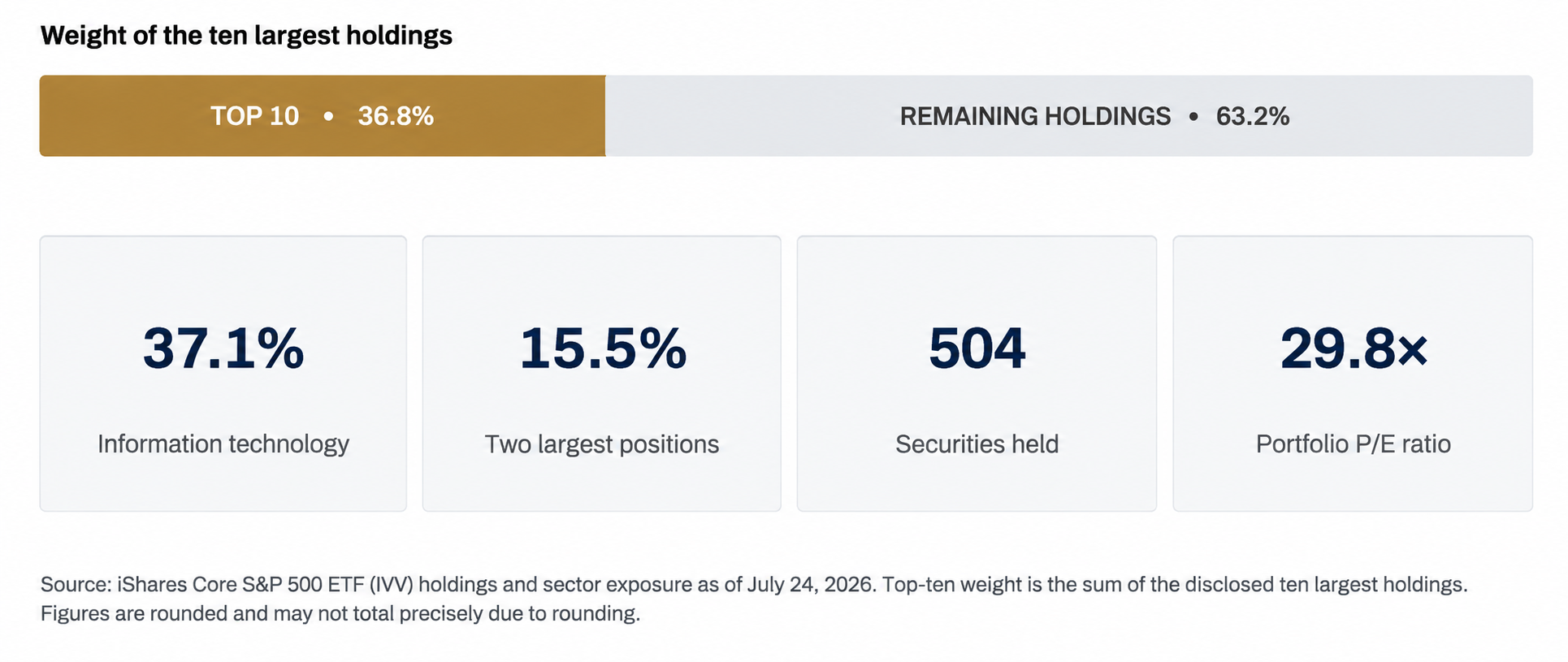
The S&P 500 is not an investment strategy. It is a commercial benchmark… one of dozens and dozens of commercial benchmarks available from multiple providers… S&P, Russell, MSCI, CRSP, etc. It is also a market-cap-weighted index, which means the largest companies receive the largest allocations. It contains ~500 stocks, but not 500 equal bets. By July 24, its ten largest holdings represented about 36.8% of the index; information technology represented 37.1%; and the two largest positions alone were 15.5%. The index held 504 securities, but the economic exposure was far from evenly distributed.
The S&P 500 is unusually dependent on a small group of very large companies and on one sector. Today, it has evolved to be dominated by mostly a handful of tech stocks.
We’re happy to own technology stocks, but in the right proportion.
Our clients own many of the world’s most innovative and profitable technology companies through diversified portfolios. We are certainly not anti-tech; far from it… we just don’t worship it. We are anti-uncompensated concentration and anti-price-insensitive storytelling. A market-cap-weighted index gives a larger voice to companies as their market values grow. That can be a desirable feature, but it also means recent winners can quietly become the portfolio’s dominant risk.
By maintaining broader U.S. exposure and deliberate tilts to small, value, and profitability, along with meaningful international holdings, we reduce reliance on one sector, one valuation regime, and one set of companies. The goal is not to bet against the leaders. It is to make sure the entire financial plan is not dependent on their success.
Broad diversification also protects against the opposite error: missing the rare companies that create most of the market’s wealth. Hendrik Bessembinder’s research found that the best-performing 4% of U.S. stocks accounted for the market’s entire net gain over Treasury bills from 1926 through 2016. The lesson is not to concentrate in the four percent because we do not know their identities in advance. The lesson is to own the market broadly enough that they are difficult to miss.
More Than Just Investment Returns
The most valuable return this year may be the behavioral return: avoiding the temptation to abandon a sound plan. Chasing performance can impose several costs at once: buying after a run-up, selling what has lagged, realizing taxes, increasing concentration, and making the portfolio more dependent on a narrative that everyone else already knows.
Having small-cap value, micro-cap, large-value, and international exposure in place before market leaders shifted meant investors benefited without needing to predict the shift. That is a more durable advantage than correctly naming the next shiny object.
The Advantage That Does Not Make Headlines
Market leadership will change again. Small and value will disappoint at times. Technology will again dominate headlines. International stocks will alternate between indispensable and apparently pointless. The good news is that we do not need to know the sequence to have a great long-term investment experience.
What we need is a process sturdy enough to survive it: broad diversification, evidence-based tilts, disciplined rebalancing, tax-aware implementation, and enough humility to admit that the future is not required to resemble the recent past.
Low-cost, evidence-based, globally diverse investing should occasionally feel boring. That is not a glitch in the matrix. It is often what discipline feels like before its requirement becomes obvious in hindsight. It is a tough strategy to follow because no one breaks out the champagne and confetti to celebrate the trends you did not chase.
Well, no one except for Rockwood, that is…

John, a New Hope, Pennsylvania native, is the Founder and CEO of Rockwood Wealth Management. A former nuclear engineer, he is committed to the development and growth of conflict-free comprehensive financial planning and investment management. John values a client-centric practice and unwavering integrity in all of our endeavors as stewards of our clients' best interests.